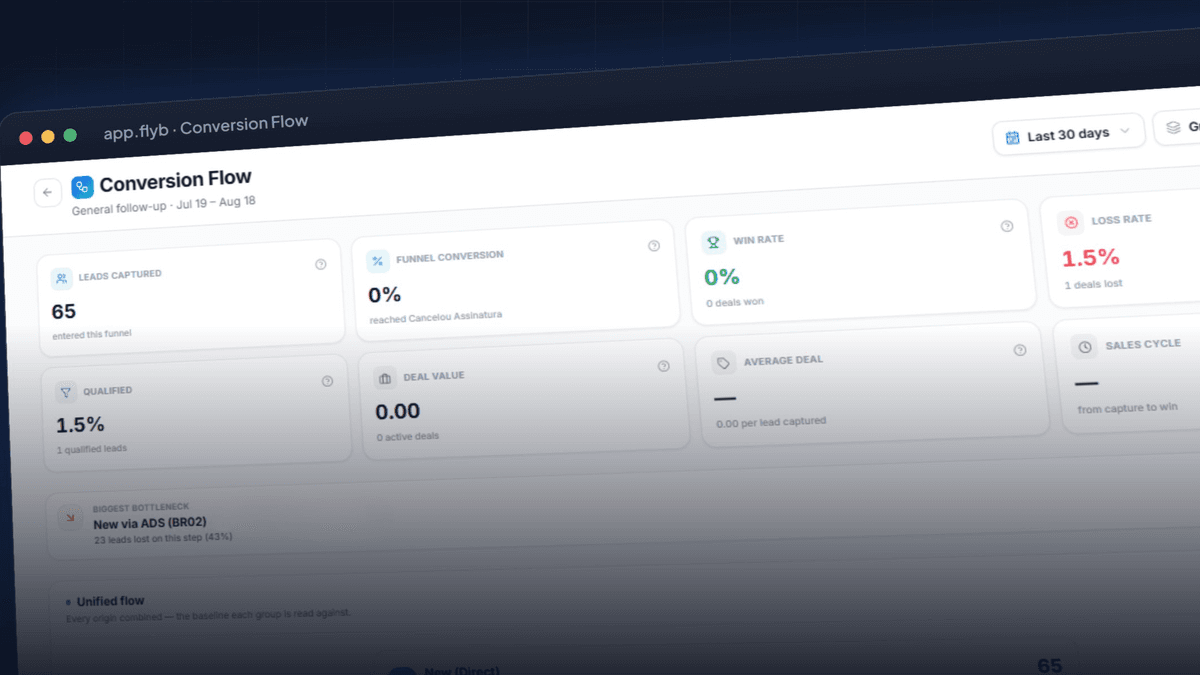
What a CRM Is and Why It's Essential for Your Company's Growth
From spreadsheets to autopilot: what a CRM is, why it matters, and how FlyB connects your landing page and automation in one flow.
Increasing customer retention by just 5% can boost a company's profits by up to 95%. That's not a marketing number — it's the result of a landmark study conducted by Frederick Reichheld at Bain & Company, published by Harvard Business Review.
The lesson behind that number is simple: sustainable growth doesn't only depend on constantly acquiring new leads. It depends on not letting go of the people who've already shown interest. And the tool that supports that control is the CRM.
The problem is that most companies treat their CRM as an isolated piece — disconnected from the landing page, from email, from WhatsApp. The result is duplicated work, lost data, and leads that go cold without anyone noticing.
What a CRM actually does
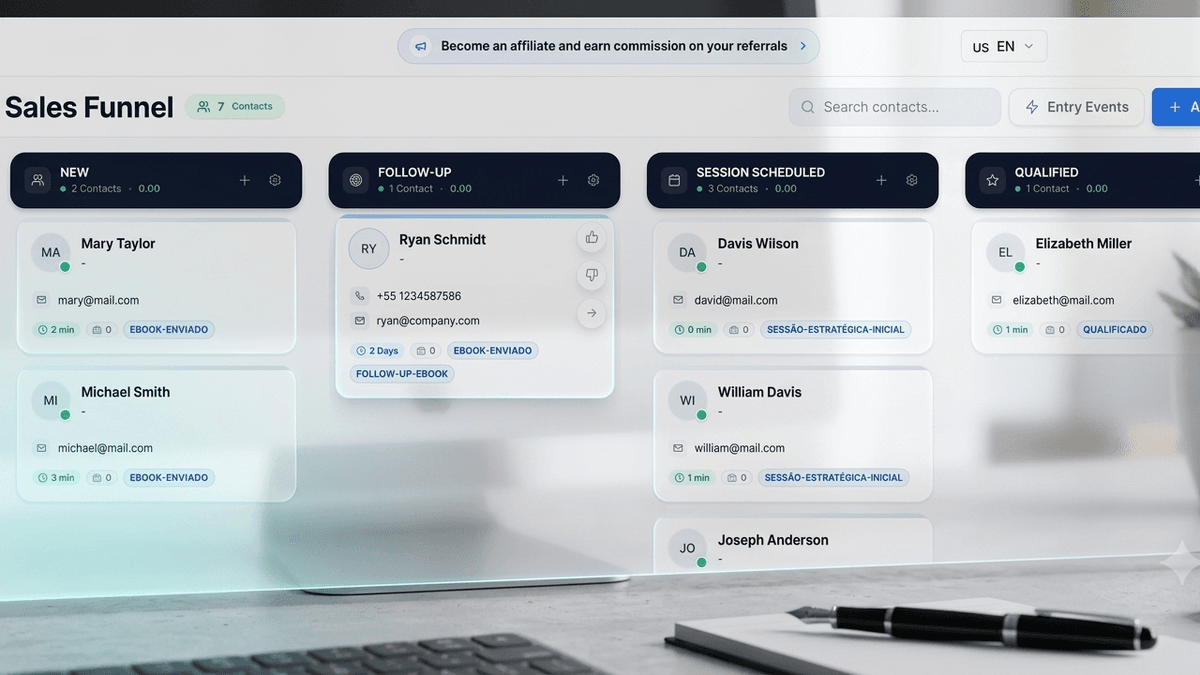
CRM stands for Customer Relationship Management. It's the system that centralizes every contact and every stage of the relationship with a lead, from the first click on your page to post-sale.
In practice, a good CRM answers three questions every sales team should be able to answer at any moment:
- Who's genuinely interested? Which leads have shown real signs of purchase intent.
- Where are they in the journey? Still discovering the solution, evaluating budget, or already negotiating.
- What's the next step? What needs to happen now so the conversation doesn't go cold.
Without a CRM, those answers live scattered across a salesperson's personal WhatsApp, loose notes, overflowing inboxes, and spreadsheets that go out of date the moment they're created.
The real cost of managing sales through spreadsheets
At first, a spreadsheet feels like enough. But as the team grows and new traffic channels come into play, that simple model quickly becomes a bottleneck.
| Stage | Manual spreadsheet | CRM integrated with the landing page |
|---|---|---|
| Lead capture | Copied and pasted manually, sometimes hours later | Enters automatically, with the full form data |
| First contact | Depends on someone remembering to check email | Instant alert to the sales team |
| Conversation history | Scattered across chats and the team's memory | Single record, with the full interaction history |
| Data security | Easily lost when someone leaves the company | Controlled access, data centralized within the company |
The core point: today, losing a lead's attention happens in seconds. If they fill out your form and only hear back hours later, chances are they've already moved on to a competitor.
From landing page to CRM: closing the leaks in your funnel
The biggest loss of sales opportunities doesn't come from a lack of traffic — it comes from the leaks between capturing a lead and actually starting the conversation.
In a traditional setup, with fragmented tools, that path turns into a puzzle: the landing page sits on one platform, the data passes through an external connector, moves on to an automation tool, and only then reaches the CRM. Every one of those steps is a point where the integration can fail — and the lead sits there, unnoticed.
At FlyB, that path is direct:
- The lead lands on the page.
- Fills out the form.
- Enters the CRM funnel automatically — no intermediate steps, no external integration to set up.
There's no data handoff between different systems, because the landing page and the CRM are already connected by design.
Autopilot: what automation actually solves
Having your data centralized already helps a lot. But the real jump in efficiency happens when the process no longer depends on someone remembering to act. That's where automation comes in:
Welcome sequence As soon as a lead fills out the form, they get an automatic response — a thank-you, next steps, or even an invite to book a call.
Automatic segmentation Depending on which offer or page the lead visited, they get tagged and routed to the right content — without anyone having to sort it manually.
Sales team routing The contact arrives already organized and assigned to the right person on the team, without depending on someone to manually hand it off.
Follow-up reminders Automatic alerts before meetings and scheduled follow-ups prevent a lead from being forgotten — or a booked meeting from turning into a no-show.
Running on autopilot, or on memory?
It's worth asking: today, does lead follow-up at your company run on reliable, automatic rules — or does it depend on the memory of someone already stretched thin?
Every follow-up lost to a process failure — not a lack of interest from the lead — is revenue that was already spent on marketing and never came back. Connecting the landing page, CRM, and automation into a single flow, the way FlyB does, is what turns lead acquisition into predictable, recurring growth.