SEO and GEO: Why Your Business Needs a Blog in the AI Era
When Google shows an AI summary, clicks on organic results drop from 15% to 8%. Here's what changes between SEO and GEO, what an article needs in order to be cited by ChatGPT, Gemini and Perplexity, and how FlyB's native blog gets you publishing without a plugin or an extra tool.
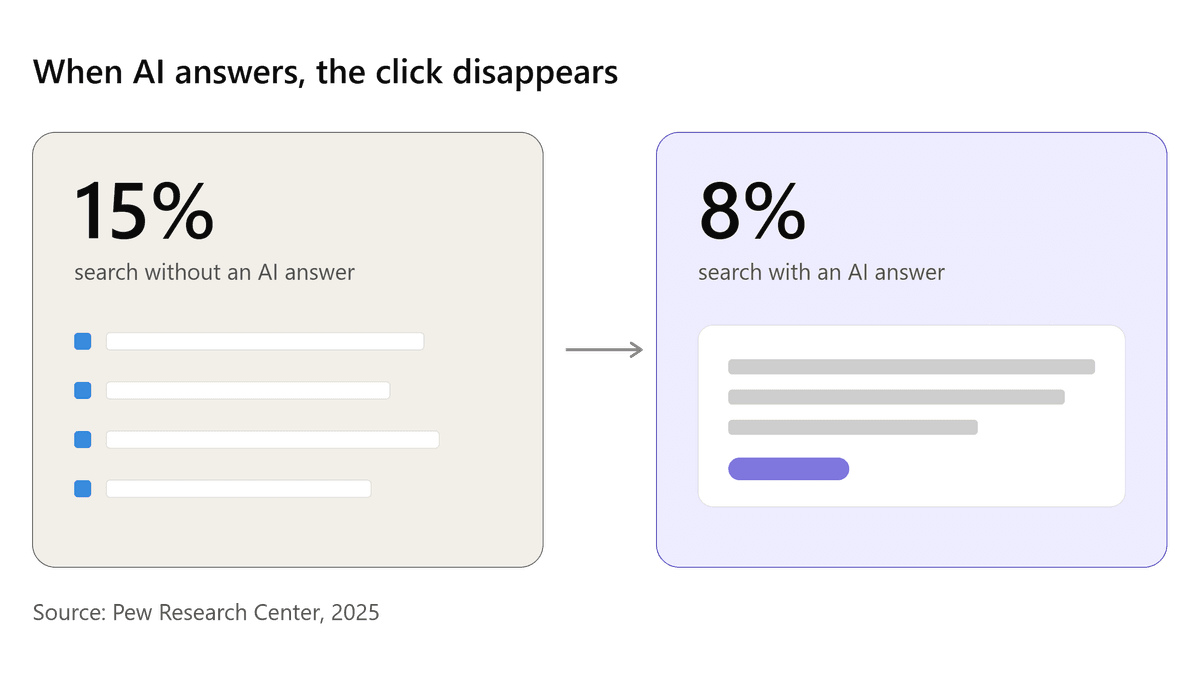
One number sums up the shift: when Google shows an AI-generated summary at the top of the page, users click an organic result in 8% of visits. When it doesn't, they click in 15%. The links cited inside the summary itself get clicked in only 1% of visits (Pew Research Center, July 2025, based on 68,879 real searches from 900 US adults).
In other words, ranking well on Google no longer guarantees the traffic it used to. And the competition is no longer only about position. It's about being the source the AI uses to build its answer.
That's the territory of GEO (Generative Engine Optimization), the practice of optimizing for generative engines like ChatGPT, Gemini, Copilot and Perplexity. And one asset decides who makes it into those answers: the corporate blog.
In this article you'll see what the data says about this transition, why the blog became the central asset, what has to exist inside each article for an AI to cite it, and how FlyB removes the tedious part of the process.
What changed, in numbers
Search hasn't disappeared. What changed is where attention goes after the question.
- The answer became the final destination. Around 60% of Google searches end without a single click to an external site. With an AI summary on screen, the session ends on 26% of visits, compared with 16% on pages without one (Pew Research Center, 2025).
- Position one lost value. Ahrefs compared 150,000 keywords that trigger an AI summary against 150,000 that don't, using Search Console data from December 2023 and December 2025: click-through rate at position one fell 58% on queries with a summary (Ahrefs, February 2026).
- The assistant became a discovery channel. ChatGPT reached 900 million weekly active users in February 2026, up from 400 million a year earlier (OpenAI). The clicks it sends out to websites grew roughly 206% between January 2025 and January 2026 (Semrush, clickstream analysis).
- Low volume, high quality. AI traffic still accounts for something like 1% of total sessions, but it converts on average 4.4 times better than traditional organic (Semrush, June 2025). These are visitors who already did their research inside the chat and arrive ready to decide.
The practical reading is simple: fewer clicks per query, and far more weight on being remembered, cited and recommended inside the answer.
SEO and GEO aren't competing
GEO doesn't replace SEO, it rests on it. A site an AI can't crawl and understand doesn't get cited. The difference is in what each layer is aiming for.
| Criterion | Traditional SEO | GEO (optimizing for generative AI) |
|---|---|---|
| Main goal | Rank at the top of search results | Be cited as a reference in the answer |
| Technical structure | Exact-match keywords, tags, backlinks | Conceptual coherence, context, verifiable data |
| Ideal format | Short lists, video, visuals | Technical depth and concrete examples |
| Content type | Straightforward guides and how-tos | Case studies, analyses and practical articles |
| Success metric | Average position, clicks, CTR | Frequency of brand mentions and citations |
There's one detail in this transition that tends to surprise anyone coming from classic SEO: according to a Semrush study, around 90% of the pages ChatGPT cites rank at position 21 or lower for related queries. Being outside Google's top three doesn't stop your company from being cited. What counts is whether the content answers the question clearly and in depth.
For a mid-sized company, that's the best news in years. The fight for authority is about content again, not just about a link-building budget.
Why the blog became the central asset
Sales landing pages are still essential for immediate conversion. But they're short by design, focused on one offer, and they don't provide the context generative models use to cross-reference information. What answers the market's real questions is the blog.
1. E-E-A-T (Experience, Expertise, Authoritativeness and Trust) These criteria come from the guidelines Google gives its human search quality raters. They aren't a direct ranking factor, but they describe well the kind of signal both Google and AI models use to decide who to trust. A consistent blog shows there's real knowledge behind the domain, something a single sales page has no way to prove.
2. A primary source for AI engines Articles that explain the problem, the solution and the outcome, with data and examples, are exactly the material these tools cut from to form answers. A promotional banner isn't citable. A clear explanation is.
3. Traffic that doesn't stop when the budget does Most companies still settle for a one-page website. An active content section generates continuous organic traffic, unlike paid campaigns, which stop the day the card gets declined.
What has to exist inside the article
Here's the tactical part almost no article about GEO explains. If you want to be cited, your content has to be easy to excerpt. In practice:
- Headings phrased as questions. Searches of ten words or more trigger an AI summary 53% of the time, and queries starting with "who," "what" or "why" do so 60% of the time (Pew, 2025). Write your subheadings the way people ask.
- Self-contained answers. Each section should deliver the full answer in two or three sentences before going deeper. The model cites the passage, not the whole article.
- Data with a source and a date. "CTR has dropped" is easy to ignore. "CTR at position one fell 58%, according to Ahrefs in February 2026" is citable.
- One strong claim per section. Short, definitive sentences, the kind that fit whole inside an answer, raise your odds of showing up in one.
- An FAQ block at the end. Question-and-answer format is the closest thing to what the model already produces. It's the most reused part of any article.
- Let the crawler in. If your robots.txt blocks AI crawlers, or if your content only appears after a JavaScript render, you don't exist to those models.
One measurement warning: a large share of AI-originated visits arrive with no referrer and get logged as direct traffic in analytics. If you only look at the channel report, you'll undercount the result. Also track brand mentions inside the assistants themselves, by asking them what they recommend in your category.
How this plays out in practice
Here's the full path, the kind of thing that happens dozens of times a day in any B2B niche.
Someone types into ChatGPT: "which tool should a small agency use to build a landing page with an integrated CRM?" The model doesn't return ten links. It returns three or four names with a sentence of reasoning for each. To make that list, your company needs a text somewhere crawlable that explains this specific scenario, with the problem, the comparison and the outcome.
No product landing page does that. A blog article does. And when the user clicks, they arrive already convinced, which explains the 4.4x conversion difference Semrush measured.
The real obstacle: keeping a blog running takes work
Almost every marketing leader knows they need a blog. The problem is the process. In practice, it runs into two issues.
Technical maintenance. On WordPress, plugins pile up over time and eventually cost you in performance, and every update carries a risk of breaking a layout or opening a security hole. Plenty of marketing teams end up needing a developer just to publish a post.
Separate tools. Platforms built only for content charge on top of everything else, and cheaper plans usually cap how many team members can log in. The blog becomes one more subscription, one more login, one more report disconnected from the rest of the funnel.
The result is that many companies give up on exactly the asset they need most right now.
How FlyB solves this
FlyB includes a native blog on every plan, including the free one, integrated with the rest of the platform. No plugin, no separate tool, no extra cost.
AI content generation inside the platform You don't start from a blank page. FlyB generates articles from a topic or a simple brief, and the text serves as a starting point you can edit before publishing. That's what makes the cadence SEO and GEO demand possible without hiring a writing team.
Markdown writing and scheduling You write in Markdown, set the category and schedule the publication. Your cadence stops depending on someone remembering to upload the post on Wednesday.
As many blogs as the business needs Each one with its own address, category tree and theme. Agencies run one per client. Companies with more than one product run one per brand.
Essential SEO in the editor Meta title, meta description and mobile preview are already in the editing panel, with nothing to install. Published articles use a structure optimized for fast loading, which helps both reading and indexing by search engines and AI.
The whole funnel in one place At the end of an article, the reader moves on to a landing page, a form wired into the CRM, a booking or a Stripe checkout. The contact enters the CRM with automated follow-up, and native Analytics shows where your best customers came from. No stitching four tools together to close the loop.
Get started today
Semrush projects that traffic from AI-powered search will overtake traditional organic by 2028. Whoever starts publishing now will have two years of indexed content by the time that happens. Whoever waits will be competing for space in answers their competitors already occupy.
With FlyB's native blog and built-in AI content generation, putting this into practice takes no technical team, no plugin and no extra tool.
Create your free FlyB account and publish your first article today.